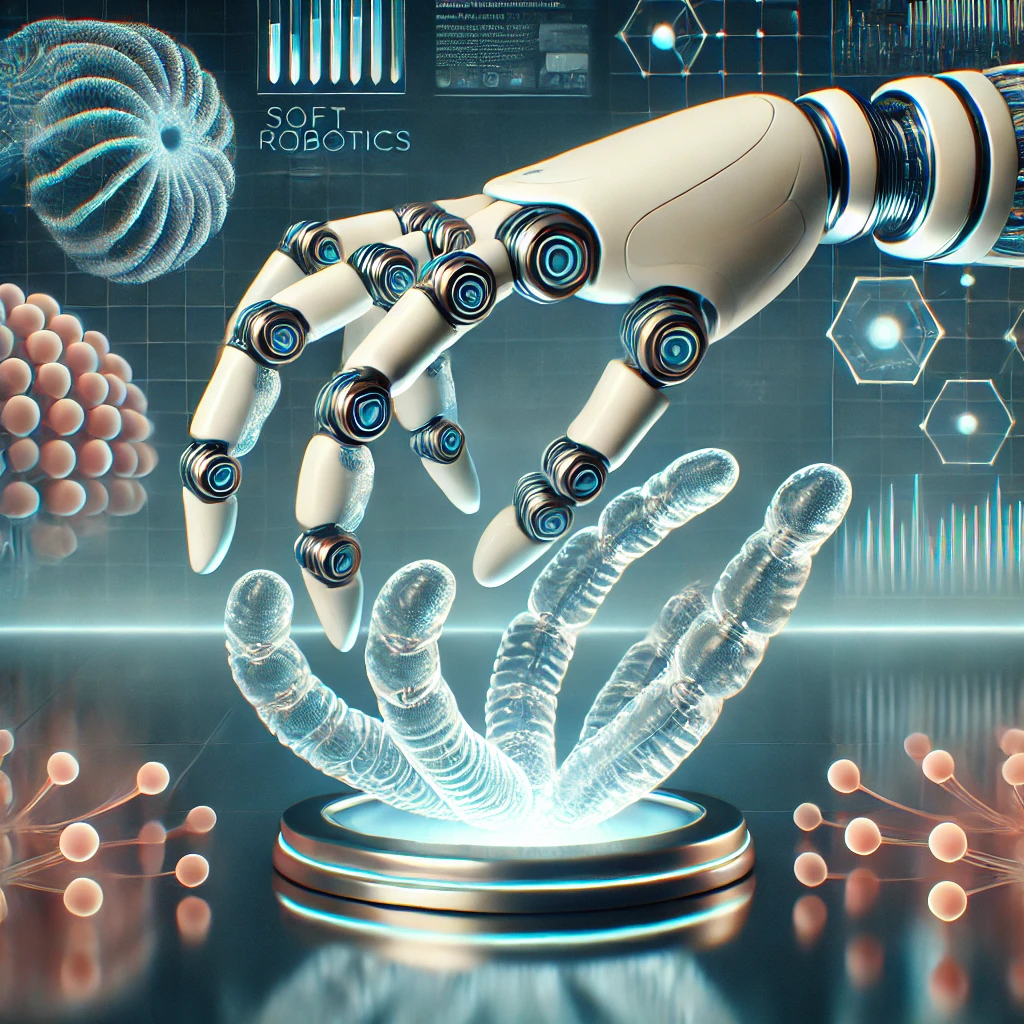
Most people imagine robots as rigid, metallic machines—but what if robots could be soft, flexible, and even mimic human muscles? This is the concept behind soft robotics, a revolutionary field that uses bendable materials to create robots that can move like living creatures.
Soft robots are already being used in medicine, space exploration, and industrial automation. But how do they work? And how will they shape the future of robotics?
In this article, we’ll explore:
✅ How soft robotics works and how it differs from traditional robots 🔬
✅ Applications in healthcare, space exploration, and disaster response 🚑🌌
✅ The challenges and future possibilities of soft robots 🚀
Let’s dive into the world of next-generation flexible robots! 🤯✨
Soft robotics is a subfield of robotics that focuses on creating flexible, deformable robots using materials like silicone, rubber, and artificial muscles.
| Feature | Traditional Robots 🤖 | Soft Robots 🦠 |
|---|---|---|
| Structure | Rigid metal or plastic | Soft, flexible materials |
| Movement | Mechanical joints & motors | Deformable structures |
| Durability | Can break under pressure | Can absorb impact |
| Use Cases | Factories, military, AI | Healthcare, space, delicate tasks |
📌 Fun Fact: Some soft robots are inspired by nature, mimicking the movements of octopuses, jellyfish, and worms! 🐙
Soft robots don’t use traditional motors and gears. Instead, they rely on:
✔️ Made of hydrogels, elastomers, or shape-memory alloys.
✔️ Expand and contract like real muscles, allowing smooth movement.
📌 Example: Scientists have created a soft robotic hand that can gently pick up fragile objects, like eggs or fruit! 🥚
✔️ Soft robots can move using air (pneumatic) or liquid (hydraulic) pressure.
✔️ Allows for smooth, organic movement without rigid joints.
📌 Example: The Octobot, a fully soft robot, uses air pressure to move like an octopus! 🐙
✔️ Some researchers are integrating real muscle cells with robots, creating “biohybrid” machines.
✔️ These robots could one day repair themselves like living organisms.
📌 Future Vision: Could soft robots replace damaged human organs or create living prosthetics?
Soft robots are already being tested in medicine, space exploration, and industry.
✔️ Soft robots can navigate inside the human body for delicate procedures.
✔️ Can be used for minimally invasive surgeries, reducing recovery time.
📌 Breakthrough: Scientists created a soft robot that can crawl inside the intestines to perform medical procedures! 🤯
✔️ Soft robotic exosuits help patients with paralysis regain movement.
✔️ More comfortable and lightweight than rigid prosthetics.
📌 Example: Harvard’s soft robotic glove helps stroke patients regain grip strength.
✔️ Soft robots can adapt to extreme environments like Mars or the deep sea.
✔️ NASA is testing inflatable robots that can survive space travel.
📌 Future Potential: Could a soft robot explore alien planets without breaking? 🪐
✔️ Soft robots can squeeze through tight spaces after earthquakes or building collapses.
✔️ Can operate in dangerous areas where humans or rigid robots can’t go.
📌 Example: A snake-like soft robot can crawl through rubble to find trapped survivors. 🐍
✔️ Used in factories for handling delicate materials like glass or electronics.
✔️ Can work alongside humans without causing injuries.
📌 Example: Soft robotic arms in warehouses can pack fragile items without breaking them. 📦
Despite its potential, soft robotics still faces major challenges:
✔️ Soft robots need efficient energy sources—current power systems are too bulky.
✔️ Scientists are exploring wireless charging and self-powered materials.
📌 Could future soft robots be powered by solar energy or body heat?
✔️ Soft robots are difficult to control due to their flexible nature.
✔️ Advanced AI and machine learning are being developed to improve movement.
📌 Can soft robots learn to move as efficiently as human muscles?
✔️ Soft materials can degrade faster than metal.
✔️ Scientists are developing self-healing polymers to make robots last longer.
📌 Future Vision: Imagine a soft robot that can repair itself when damaged, just like skin! 🤯
Soft robotics is expected to grow rapidly in the coming decades.
| Year | Predicted Soft Robotics Development |
|---|---|
| 2025 | Soft robots used for medical procedures & prosthetics. |
| 2030 | Fully autonomous soft robots for disaster response. |
| 2040 | Biohybrid robots with living muscle tissues. |
| 2050+ | Soft robots that learn, self-heal, and evolve like living organisms. |
📌 Could we see completely organic robots that mimic human bodies by 2050?
Soft robots could have huge societal impacts, but they also raise important ethical questions:
🤖 Will soft robots replace human workers in healthcare and industry?
🧠 Could biohybrid robots challenge our definition of life?
⚠️ What happens if self-repairing robots become uncontrollable?
📌 Future Regulation: Governments may need to create laws to prevent misuse of soft robots.
Soft robotics is changing the future of technology, offering robots that are safer, more adaptable, and even biologically inspired. From medical treatments to space exploration, these flexible machines could reshape our world in ways we never imagined.
But as soft robots become more advanced and lifelike, we must carefully consider their ethical and technological impact.
🌟 Could soft robots become as common as smartphones in the next 50 years? The future is closer than we think! 🌟
📌 Key Takeaways:
✅ Soft robots use flexible materials instead of rigid metal.
✅ They are used in medicine, space, industry, and disaster response.
✅ Challenges include power, precision, and durability.
✅ Future robots may be biohybrid, combining organic tissue with machines.
✅ Ethical concerns exist over job replacement and robotic autonomy.
🔥 Would you trust a soft robot to perform surgery or assist in daily life?🔥
When analyzing a stock, one of the first financial indicators you’ll encounter is EPS, or Earnings Per Share. It’s one… Read More
When you look at a stock’s profile on a financial website, one of the first things you’ll see is its… Read More
In the world of open-source software, simplicity and flexibility are often just as important as legal protection. That’s why the… Read More
If you want your software to be open source, but still compatible with commercial use—and not as restrictive as the… Read More
When it comes to open-source software, developers and businesses alike need licenses that balance freedom, legal clarity, and long-term security.… Read More
If you’re working on open-source projects or choosing third-party libraries for your software, understanding software licenses is essential. Among the… Read More