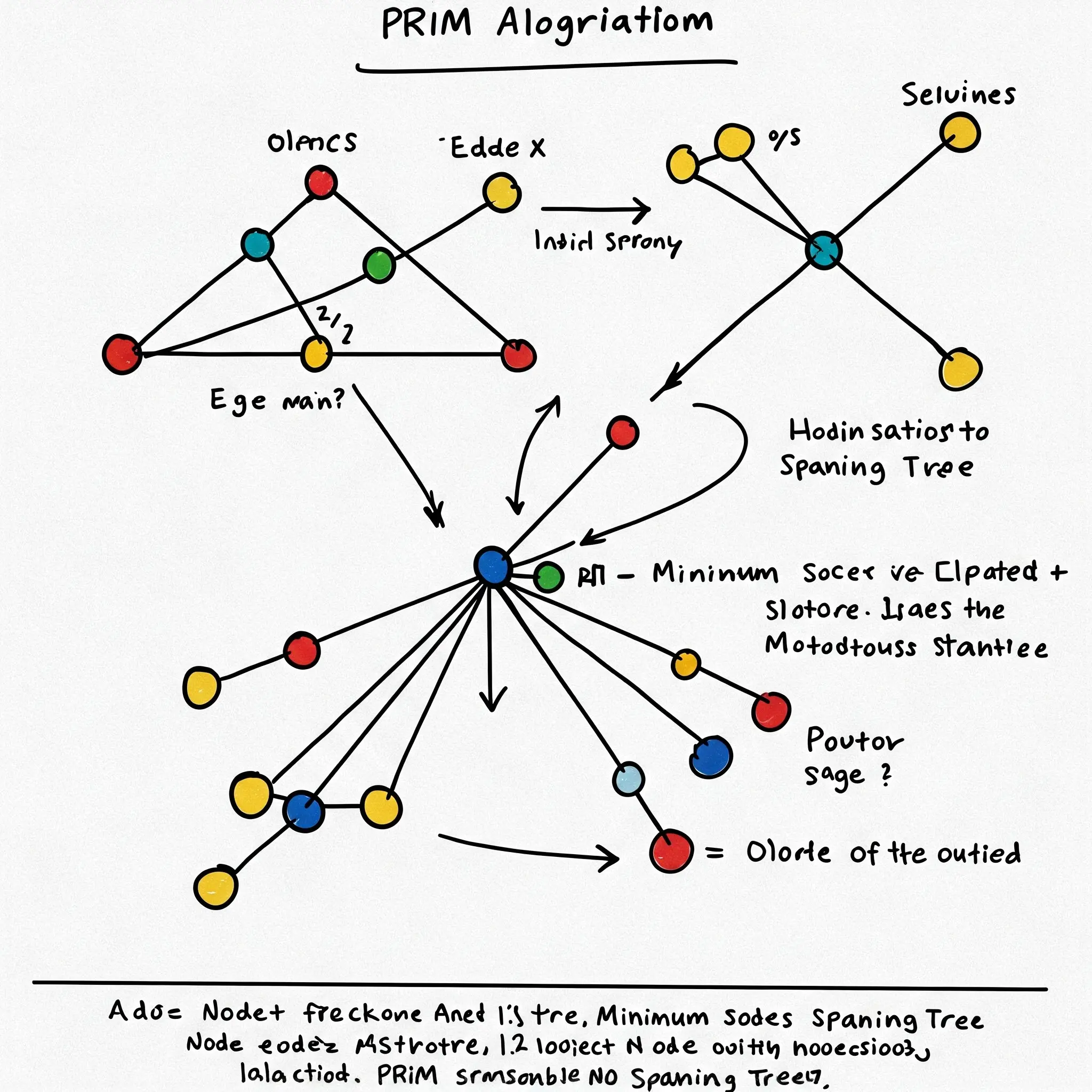
Prim’s Algorithm is one of the classic approaches for finding a Minimum Spanning Tree (MST) in a weighted undirected graph. It begins from any chosen start vertex, then repeatedly selects the cheapest edge (in terms of weight) connecting the current MST to a vertex not yet in the MST. It often uses a priority queue (min-heap) and can achieve O(E log V) complexity with an adjacency list representation.
Below is an example using an adjacency list and a priority queue to implement Prim’s algorithm.
import java.util.*;

class Edge {
    int to;
    int weight;

    public Edge(int to, int weight) {
        this.to = to;
        this.weight = weight;
    }
}

public class PrimExample {
    private List<List<Edge>> graph; // Adjacency list
    private int vertexCount;

    public PrimExample(int n) {
        vertexCount = n;
        graph = new ArrayList<>();
        for (int i = 0; i < n; i++) {
            graph.add(new ArrayList<>());
        }
    }

    public void addEdge(int u, int v, int weight) {
        // Undirected edge
        graph.get(u).add(new Edge(v, weight));
        graph.get(v).add(new Edge(u, weight));
    }

    public int primMST(int start) {
        boolean[] visited = new boolean[vertexCount];
        int mstCost = 0;
        int edgeCount = 0;

        // Priority queue storing edges as (weight, destination)
        PriorityQueue<Edge> pq = new PriorityQueue<>(Comparator.comparingInt(e -> e.weight));

        // Mark the start vertex as visited and add its edges
        visited[start] = true;
        for (Edge e : graph.get(start)) {
            pq.offer(e);
        }

        // Continue until we've chosen V-1 edges or the queue is empty
        while (!pq.isEmpty() && edgeCount < vertexCount - 1) {
            Edge currentEdge = pq.poll();
            int nextVertex = currentEdge.to;
            int w = currentEdge.weight;

            if (visited[nextVertex]) {
                // Already in MST
                continue;
            }

            // Add the new vertex to MST
            visited[nextVertex] = true;
            mstCost += w;
            edgeCount++;

            // Add adjacent edges from this newly added vertex
            for (Edge adj : graph.get(nextVertex)) {
                if (!visited[adj.to]) {
                    pq.offer(adj);
                }
            }
        }

        return mstCost;
    }
}
public class PrimTest {
    public static void main(String[] args) {
        int n = 6; // Number of vertices
        PrimExample primGraph = new PrimExample(n);

        // Add undirected edges: (u, v, weight)
        primGraph.addEdge(0, 1, 4);
        primGraph.addEdge(0, 2, 2);
        primGraph.addEdge(1, 2, 5);
        primGraph.addEdge(1, 3, 10);
        primGraph.addEdge(2, 4, 3);
        primGraph.addEdge(2, 5, 7);
        primGraph.addEdge(3, 4, 6);
        primGraph.addEdge(4, 5, 1);

        // Start Prim's from vertex 0
        int mstCost = primGraph.primMST(0);
        System.out.println("Prim MST Cost: " + mstCost);
        // Example result: 16, depending on the structure
    }
}
Below is a similar approach using a list of adjacency information and a priority queue (heapq in Python).
import heapq

class PrimExample:
    def __init__(self, n):
        self.n = n
        # Adjacency list: graph[u] = [(weight, v), ...]
        self.graph = [[] for _ in range(n)]

    def add_edge(self, u, v, weight):
        # Undirected edge
        self.graph[u].append((weight, v))
        self.graph[v].append((weight, u))

    def prim_mst(self, start):
        visited = [False] * self.n
        mst_cost = 0
        edge_count = 0

        # Priority queue with (weight, vertex)
        pq = []
        visited[start] = True

        # Add edges from start vertex
        for w, nxt in self.graph[start]:
            heapq.heappush(pq, (w, nxt))

        # Repeat until we have n-1 edges or run out of edges
        while pq and edge_count < self.n - 1:
            w, nxt = heapq.heappop(pq)
            if visited[nxt]:
                continue

            visited[nxt] = True
            mst_cost += w
            edge_count += 1

            # Add new edges from the newly visited vertex
            for adj_w, adj_v in self.graph[nxt]:
                if not visited[adj_v]:
                    heapq.heappush(pq, (adj_w, adj_v))

        return mst_cost
def test_prim():
    n = 6
    prim_graph = PrimExample(n)

    # (u, v, weight)
    prim_graph.add_edge(0, 1, 4)
    prim_graph.add_edge(0, 2, 2)
    prim_graph.add_edge(1, 2, 5)
    prim_graph.add_edge(1, 3, 10)
    prim_graph.add_edge(2, 4, 3)
    prim_graph.add_edge(2, 5, 7)
    prim_graph.add_edge(3, 4, 6)
    prim_graph.add_edge(4, 5, 1)

    mst_cost = prim_graph.prim_mst(0)
    print("Prim MST Cost:", mst_cost)
    # For instance, might print 16

if __name__ == "__main__":
    test_prim()
| Aspect | Prim’s Algorithm | Kruskal’s Algorithm |
|---|---|---|
| Data Structure | Priority queue (min-heap) + adjacency list/ matrix | Sort edges + Union-Find |
| Approach | Vertex-centric: expand MST via min-edge from MST set | Edge-centric: pick edges in ascending weight |
| When to Use | Good for dense graphs (many edges) | Good for sparse graphs (fewer edges) |
When analyzing a stock, one of the first financial indicators you’ll encounter is EPS, or Earnings Per Share. It’s one… Read More
When you look at a stock’s profile on a financial website, one of the first things you’ll see is its… Read More
In the world of open-source software, simplicity and flexibility are often just as important as legal protection. That’s why the… Read More
If you want your software to be open source, but still compatible with commercial use—and not as restrictive as the… Read More
When it comes to open-source software, developers and businesses alike need licenses that balance freedom, legal clarity, and long-term security.… Read More
If you’re working on open-source projects or choosing third-party libraries for your software, understanding software licenses is essential. Among the… Read More