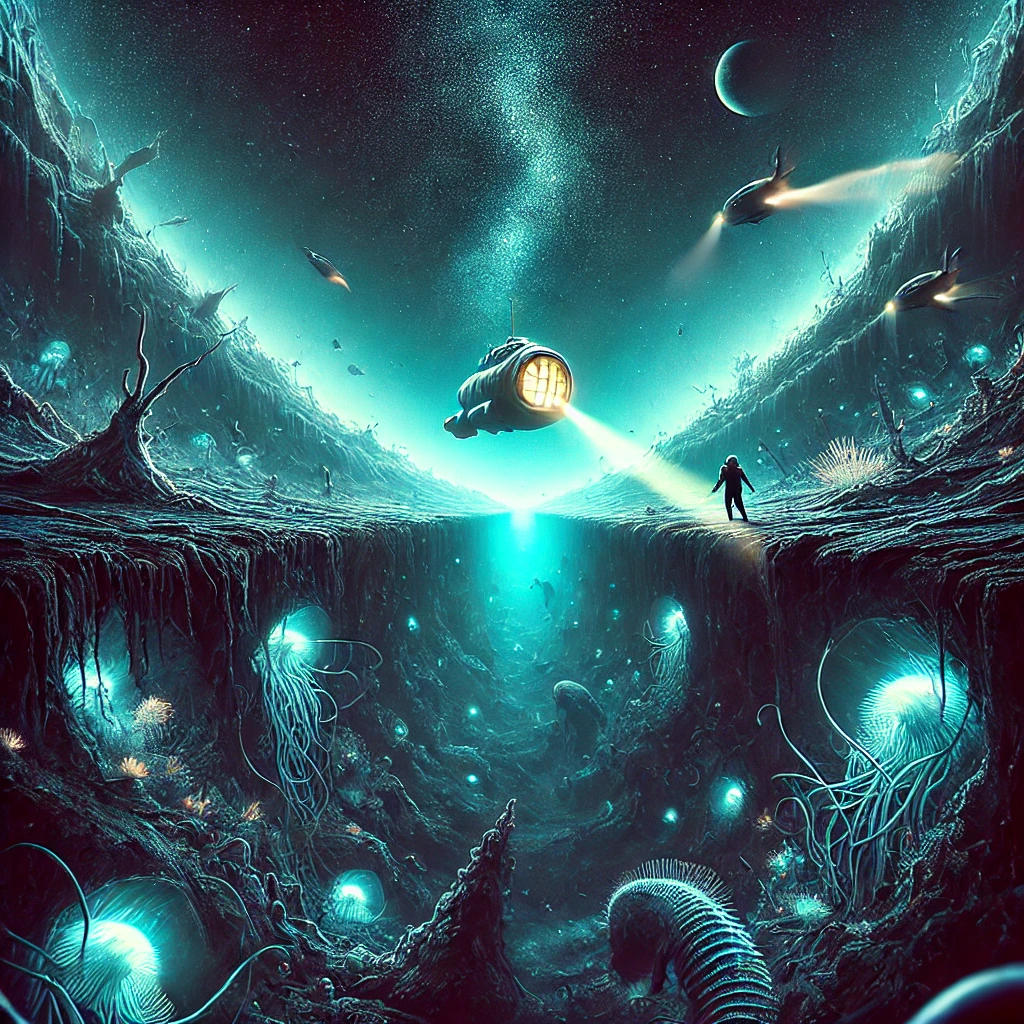
The ocean covers over 70% of Earth’s surface, yet more than 80% of it remains unexplored. While space travel captures the world’s imagination, the deep sea holds some of the most mysterious and alien environments on Earth.
But what exactly lies in the deepest parts of the ocean? What kinds of creatures survive in total darkness, under extreme pressure? And how are scientists uncovering these hidden depths?
In this article, we’ll explore:
✅ The five deepest points in the ocean 🌎
✅ The extreme conditions of the deep sea 🦑
✅ The strangest creatures found in the abyss 👀
✅ How humans are exploring these uncharted depths 🚢
Let’s dive into the unknown! 🌊✨
The ocean is divided into five depth zones, each with unique conditions and ecosystems.
🌊 Epipelagic Zone (0–200m) – The sunlit surface layer where most marine life lives.
🌊 Mesopelagic Zone (200–1,000m) – The “twilight zone”, where light begins to fade and strange, glowing creatures appear.
🌊 Bathypelagic Zone (1,000–4,000m) – Known as the midnight zone, home to the terrifying anglerfish and giant squid.
🌊 Abyssopelagic Zone (4,000–6,000m) – Freezing cold, pitch black, and with pressure 600 times greater than the surface.
🌊 Hadopelagic Zone (6,000–11,000m) – The deepest trenches, where only the most extreme creatures can survive.
📌 Fun Fact: Mount Everest (8,848m) could fit inside the deepest part of the ocean with over 2,000m to spare! 😲
Scientists have mapped the five deepest known locations in the world’s oceans, found within deep-sea trenches.
🌎 Mariana Trench (Pacific Ocean) – 10,994m (36,070ft) – The deepest place on Earth, home to bizarre, ghostly fish.
🌎 Tonga Trench (South Pacific) – 10,882m (35,702ft) – One of the most geologically active deep-sea regions.
🌎 Philippine Trench (West Pacific) – 10,540m (34,580ft) – A trench formed by massive tectonic plate collisions.
🌎 Kermadec Trench (South Pacific) – 10,047m (32,963ft) – Home to mysterious deep-sea crustaceans.
🌎 Puerto Rico Trench (Atlantic Ocean) – 8,376m (27,480ft) – The deepest point in the Atlantic Ocean, near the Caribbean.
📌 Mind-Blowing Fact: Only a handful of people have ever reached the bottom of these trenches—fewer than those who have walked on the moon! 🚀
At extreme depths, marine life faces three major challenges:
❌ Total Darkness – No sunlight penetrates beyond 1,000m, making vision useless for most creatures.
❌ Extreme Pressure – The pressure in deep trenches is over 1,000 times the atmospheric pressure at sea level!
❌ Freezing Temperatures – Deep-sea waters hover around 1-4°C (34-39°F).
Despite these harsh conditions, life thrives in the abyss!
The deep ocean is home to some of the most bizarre and alien-looking creatures on Earth.
🔹 Anglerfish – Uses a bioluminescent lure to attract prey in the pitch-black depths.
🔹 Giant Squid – A legendary deep-sea predator that grows up to 12m (39ft) long!
🔹 Dumbo Octopus – A cute, ear-flapping octopus found 4,000m deep.
🔹 Barreleye Fish – A fish with a transparent head, allowing it to see above and behind itself.
🔹 Faceless Fish – A deep-sea fish discovered in 2017 with no visible eyes or mouth.
📌 Bioluminescence: Over 90% of deep-sea creatures produce their own light using bioluminescence, helping them attract prey, communicate, or scare predators.
Since the deep sea is so extreme, exploration requires cutting-edge technology.
🌊 Bathyscaphe Trieste (1960) – The first human dive to Challenger Deep, led by Jacques Piccard and Don Walsh.
🌊 Deepsea Challenger (2012) – James Cameron became the first solo explorer to reach the Mariana Trench.
🌊 Five Deeps Expedition (2018-2019) – Victor Vescovo mapped and explored all five of the ocean’s deepest trenches.
📌 Future Missions: Scientists are developing autonomous submarines and AI-powered drones to explore the deep without human pilots! 🤖🌊
While space exploration gets global attention, the deep ocean remains a largely uncharted frontier. But why should we care about exploring it?
🌱 New Medicines – Deep-sea bacteria have led to the discovery of potential cancer treatments.
🌊 Climate Science – The deep ocean plays a key role in regulating Earth’s climate.
🐠 Preserving Marine Life – Studying deep-sea ecosystems helps protect endangered species.
🚀 Space Exploration – Deep-sea conditions are similar to what astronauts may encounter on ocean worlds like Europa (a moon of Jupiter).
📌 Surprising Fact: Scientists believe more than 90% of deep-sea species remain undiscovered! 👀
The deep ocean is one of the last great frontiers on Earth, hiding mysteries, strange creatures, and possibly even undiscovered ecosystems.
With new technology, we are only beginning to uncover the secrets of the abyss. Who knows? The next major discovery could reveal a species unlike anything we’ve ever seen—or even clues to alien life on other planets! 👽🌎
🌟 The ocean’s depths are vast and unexplored—are we ready to dive deeper? 🌟
📌 Key Takeaways:
✅ The ocean is divided into five zones, with extreme conditions in the deep.
✅ The Mariana Trench is the deepest point on Earth, at nearly 11,000m.
✅ Deep-sea creatures have evolved incredible adaptations, like bioluminescence.
✅ Only a few humans have ever reached the deepest trenches—more people have walked on the Moon!
✅ Exploring the deep ocean helps us understand climate change, medicine, and even space exploration.
When analyzing a stock, one of the first financial indicators you’ll encounter is EPS, or Earnings Per Share. It’s one… Read More
When you look at a stock’s profile on a financial website, one of the first things you’ll see is its… Read More
In the world of open-source software, simplicity and flexibility are often just as important as legal protection. That’s why the… Read More
If you want your software to be open source, but still compatible with commercial use—and not as restrictive as the… Read More
When it comes to open-source software, developers and businesses alike need licenses that balance freedom, legal clarity, and long-term security.… Read More
If you’re working on open-source projects or choosing third-party libraries for your software, understanding software licenses is essential. Among the… Read More